Type of penicillin. University of bradford: annual report 1999: 'penicillin-type' find .... [pdf] detection of penicillin allergy of the immediate type by ....

[pdf] degree and stability of tolerance to penicillin in <emphasis type ....

| Penicillin target | Penicillin injection | Penicillin g sodium | Fleming penicillin | Penicillin vk 500mg used for | Life penicillin saving | It penicillin treat |

[ Penicillin and breast feeding ]

Enzymatic synthesis of a new type of penicillin

Type of penicillin. Ntibiotic-resistance genes of staphylococci are carried on plasmids (see Agrobacterium for discussion of this) that can be exchanged with Bacillus spp. and Streptococcus spp., providing the means for acquiring additional genes and gene combinations. Some are carried on transposons - segments of DNA that can exist either in the chromosome or in plasmids. It is ironic, and tragic, that the bacterium S. aureus that opened the antibiotic era with Fleming's original discovery of 1929 could also be the first to become non-treatable with the huge battery of antibiotics discovered and developed over the last 60 years. Antibiotic usage in agriculture: creating a reservoir of resistance genes? One of the fiercest public debates at present concerns the use of antibiotics in agriculture and veterinary practice. The reason for concern is that the same antibiotics (or, at least, antibiotics with the same mode of action on bacteria) are also used for human therapy. Thus, it is possible that the irres type of
 

A new type of penicillin resistance of staphylococcus aureus ...

Ponsible use of antibiotics for non-human use can lead to the development of resistance, which could then be passed onto human pathogens by transfer of plasmids. The greatest concern of all centres on the routine use of antibiotics as feed additives for farm animals - to promote animal growth and to prevent infections rather than to cure infections. It has been difficult to obtain precise figures for the amounts of antibiotics used in this way. But the scale of the potential problem was highlighted in a recent report by the Soil Association, which collated figures on the total usage of different types of antibiotic for humans and for animals: Usage (kilograms of active ingredient) Type of antibiotic Animal (1996 survey) Human (1996 or 1997 98) Cephalosporins (beta lactams, including penicillins) 121,603 314,498 Tetracyclines 323,151 47,500 Aminoglycosides (e.g. streptomycin) 37,058 5,409 Macrolides (e.g. erythromycin) 71,222 47,696 Selected data from: J. Harvey and L Mason. The Use and type of


type of penicillin:

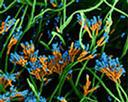
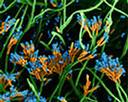
type of penicillin Aments rather like fungal hyphae type of penicillin, but only about 1 micrometre diameter. They also produce large numbers of dry type of penicillin, powdery spores from their aerial hyphae. Figure C. Edge of an agar colony of the actinomycete type of penicillin, Streptomyces griseus type of penicillin, viewed at low magnification (x10 objective of a compound microscope). Like all actinomycetes type of penicillin, this species grows as narrow filaments type of penicillin, with aerial branches that end in chains of spores. The spirally shaped aerial spore chains typical of the genus Streptomyces are seen in this image. Fig. D. Higher magnification of some of the aerial hyphae and spore chains. Actinomycetes type of penicillin, especially Streptomyces species type of penicillin, have yielded most of the antib type of penicillin.

type of penicillin Iotics used in clinical medicine today. Some examples are shown in the table below. Much useful information on these organisms can be found in Actinomycete-related WWW Sites (not on this server). Other bacteria type of penicillin, including Bacillus species (see Figure E) type of penicillin, have yielded few useful antibiotics. Fungi also have yielded few useful antibiotics. Apart from penicillin type of penicillin, the most important antibiotics from fungi are the cephalosporins (beta-lactams with similar mode of action to penicillin type of penicillin, but with less allergenicity) and griseofulvin (from Penicillium griseofulvum and related species) which is used to treat althlete's foot and related fungal infections of the skin. Figure E. Agar plate showing inhibition of fungal growth by a contaminating colony of Bacillus species. Image supplied by IW Sutherland Some clinically important antibiotics Antibiotic Producer organism Activity Site or mode of action Penicillin Penicillium chrysogenum Gram-positive bacteria Wall synthesis Cephalosporin Cephalosporium acremonium Broad spectrum Wall synthesis Griseofulvin Penicillium griseofulvum Dermatophytic fungi Microtubules Bacitracin Bacillus subtilis Gram-positive bacteria Wall synthesis Polymyxin B Bacillus polymyxa Gram-negative bacteria Cell membrane Amphotericin B Streptomyces nodosus Fungi Cell membrane Erythromycin Streptomyces ery.

type of penicillin Gure E. Agar plate showing inhibition of fungal growth by a contaminating colony of Bacillus species. Image supplied by IW Sutherland Some clinically important antibiotics Antibiotic Producer organism Activity Site or mode of action Penicillin Penicillium chrysogenum Gram-positive bacteria Wall synthesis Cephalosporin Cephalosporium acremonium Broad spectrum Wall synthesis Griseofulvin Penicillium griseofulvum Dermatophytic fungi Microtubules Bacitracin Bacillus subtilis Gram-positive bacteria Wall synthesis Polymyxin B Bacillus polymyxa Gram-negative bacteria Cell membrane Amphotericin B Streptomyces nodosus Fungi Cell membrane Erythromycin Streptomyces eryt.

type of penicillin type of
type of penicillin | link block | | | | |
type of penicillin
Ml>CAT.INIST.FRCAT.INIST.FR & 160;Qu'est-ce que CAT@INIST.FR ? & 160;& 160;©& 160;INIST-CNRS & 160;& 160;2, all& 233;e du parc de Brabois CS 10310 F-54519 & 160;& 160;Vandoeuvre-l& 232;s-Nancy Cedex & 160;& 160;FRANCE Standard : +33 (0)3 83 50 46 00 Télécopie : +33 (0)3 83 50 46 50 & 160;& 160; & 160;& 160; & 160;& 160; Titre du document Document titleEnzymatic synthesis of a new type of penicillinAuteur(s) Author(s)BALDWIN J. E. (1) ; ADLINGTON R. M. ; BASAK A. ; FLITSCH S. L. ; PETURSSON S. ; TURNER N. J. ; TING H.-H. ; Affiliation(s) du ou des auteurs Author(s) Affiliation(s)(1) Univ. Oxford, Dyson Perrins lab., Oxford OX1 3QY, ROYAUME-UNIRevue Journal TitleJournal of the Chemical Society. Chemical communications  (J. Chem. Soc., Chem. commun.)  ISSN 0022-4936   CODEN JCCCAT  Source Source1986, no12, pp. 975-976 (8 ref.)Langue LanguageAnglaisEditeur PublisherRoyal Society of Chemistry, Cambridge, ROYAUME-UNI (1972- 1995) (Revue)009 ; Localisation LocationINIST-CNRS, Cote INIST : 11990 Copyright 2006 INIST-CNRS. All rights reserved Toute reproduction ou diffusion même partielle, par quelque procédé ou sur tout support que ce soit, ne pourra être faite sans l'accord préalable écrit de l'INIST-CNRS. No part of these records may be reproduced of distributed, in any form or by any means, without the prior written permission of INIST-CNRS. Nº notice refdoc (ud4) : 8269768 & 160;& 160; & 160;& 160; & 160;& 160; phpMyVisites Open source web analytics

| Penicillin target | Penicillin injection | Penicillin g sodium | Fleming penicillin | Penicillin vk 500mg used for | Life penicillin saving | It penicillin treat |

[ Penicillin and breast feeding ]

type of penicillin© 2005
Penicillin and breast feeding site map
penicillin and breast feeding contacts: info@sony.com